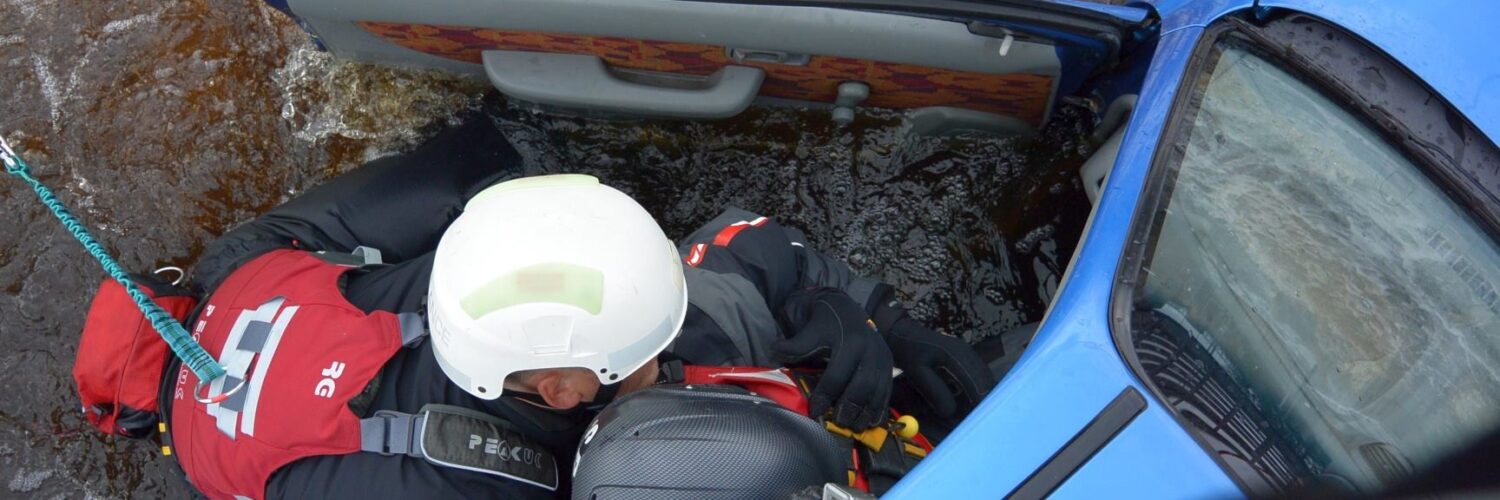
Techniques for rescues from vehicles in water
Introduction
In part one, I focused on the decision-making criteria that would drive tactical choice or dealing generally with rescues for vehicles in water. This time, I will focus on the actual techniques available to responders in rescuing a casualty from a vehicle in water.
There are several operational models (normally summed up with a catchy mnemonic) that are applicable to such incidents, but the generic rescue principles apply equally to vehicles in water, with perhaps a few provisos:
LAST (Locate, Access, Stabilise, Transport) is commonly used in water/flood related rescues and is equally applicable to rescues from vehicles in water. In its simplest version, it outlines a process where we locate the vehicle (and occupants), make initial access to get to the location of the vehicle and then stabilise (secure) the vehicle and/or occupants before finally transporting the occupants to a safe location out of the water.
Given that we are dealing with vehicles it is also worth considering the application of pathways associated with road traffic collisions. The ‘Six Phases Model’ for a Road Traffic Collision is potentially applicable to more complex rescue from vehicles in water, including where glass management may be required to create anchor points on the vehicle.
- Safety and Scene Assessment
- Stabilisation and Initial Access
- Glass Management
- Space Creation
- Full Access
- Immobilisation and Extrication
However, as identified in the TEMPOE model developed by Battalion Chief Tim Rogers of Charlotte Fire Department, with inland water incidents we need to consider that tactical choice is probably largely determined by three key factors.
- Water Energy
- Water Temperature
- Time the casualty has been in the water
Whichever technique we use to access the vehicle and transport the casualties from the vehicle, it has to be capable of coping with the energy of the water. As we saw in part one, water speed and depth are key factors for whether a car will be washed away, but equally they determine whether we could access by low energy techniques such as wading or need higher energy options like powered craft or tensioned rope solutions.
The temperature of the water and the time the casualties have been in the water are key to determining the ability of the casualty to assist in their own rescue. A number of water rescue techniques are categorised as ‘conditional rescues’ in that they only work on the condition that the casualty plays an active part in their rescue. For example, the use of a throwline deployed from the shore to a casualty on the roof of a car is only going to be successful if the casualty is able to hold onto the rope for the full duration from catching the rope to being pulled safely to the shore.
Most casualties who have been immersed in cold water and subjected to the physical and psychological stresses of being in a vehicle in moving water, cannot be relied upon to successfully participate in their own rescue and more hand’s on ‘true’ rescue techniques where the rescuers take control of the casualty are the required norm.
Vehicle access
Initial access to the vehicle and occupants is generally required if we are to stabilise the vehicle and/or make a contact rescue of the occupants. There are several techniques open to us to achieve this initial access and we can roughly categorise these into low energy and high energy options. Those in the low energy category are only applicable to low energy water conditions.
These categories would include:
Low energy
- Shallow water wade
- Paddle boat/sled
- Tethered swimmer
- 2 & 4 point tethers
High energy
- Single-bank tethered boat
- Tensioned diagonal
- Powerboat
- Highline rope systems (with or without a boat)
- Helicopter
Consideration of the application and implementation of all of these techniques is beyond the scope of this article and is best addressed practically in a Rescue from Vehicles in Water training course. Thankfully the growth in artificial white-water courses, has seen a similar growth in the availability of realistic quality training courses on this topic.
Common to most of the above techniques is the issue of where we aim for when making initial access to the vehicle. Anecdotal evidence would suggest that many vehicles in water incidents occur in very low energy/slow flow conditions and thus there is negligible risk of the vehicle moving and wading access can be made to any point around the vehicle. Indeed, there is probably a greater risk to responders and casualties from hidden siphon features under the water such as missing drainage covers than from being trapped against or by a moving vehicle.
As soon as we are faced with higher energy water conditions the upstream side of the vehicle creates a potential hazard that could result in either entrapment against the vehicle or in the siphon-like feature that is created under the car when the vehicle is sitting on a hard surface.
The downstream side of the vehicle will normally have some sort of eddy feature (unless the vehicle is pinned against a larger object) and this is often a workable area. However, if the vehicle is free to move (and water speed/level suggest that this might be possible) then anyone operating in this downstream eddy can find the vehicle moving downstream onto them!
One of the key advantages of boat/sled-based access techniques (including tethered boat options) is that we can use the boat as a working platform next to the vehicle from which we can undertake a variety of activities including stabilising/securing the vehicle and removal of the casualties from the car into the boat. Should the vehicle begin to move it is generally less consequential for boat-based rescuers operating around the car than rescuers in the water, particularly those on the downstream side of the vehicle.
Once access to the vehicle has been made we then need to put in place the next stage of the rescue as decided in the incident size up. This may involve creating anchor points on the vehicle to prevent it from moving (stabilisation) of if the decision has been made to remove the occupants without stabilising the vehicle then we need to gain access to allow for their removal. The use of
3 or 4 wading rescuers to create a wedge can be a very useful technique at this time. In addition to providing a stable set up for shallow water crossings to/from the vehicle the wedge effectively creates a mobile eddy on its downstream side. By placing the wedge immediately upstream of a door it places the door in the eddy and thus makes opening of the door and removal of the
occupants much easier.
Stabilisation
Whether or not a tactical decision is made to secure the vehicle before removing t he occupants will be a dynamic decision made at the incident based on a number of factors including those we looked at in part one:
- Water speed
- Existing and predicted water levels
- Number and condition of vehicle occupants
- Suitable bank anchors to secure the vehicle to
- Suitable anchor points on the vehicle
- Whether the vehicle is already pinned against an object that prevents it from moving further
Whilst the temptation to secure the vehicle and prevent any potential movement is understandable this needs to be balanced against the time and difficulty to provide effective stabilisation. It might well be possible to access the vehicle and undertake a quick ‘snatch’ rescue in a much shorter time than if stabilisation is put place, thus removing the occupants from the risk area more quickly. This is particularly applicable when water levels are stable/falling, and we have small numbers of occupants in the vehicle.
Assuming a decision has been made to secure the vehicle, we need to consider:
Single or twin bank stabilisation
Being able to secure the vehicle to both banks should provide the best solution in terms of preventing movement of the vehicle but this is often difficult or even impossible to achieve, particularly in flood situations where distance to the banks may be very large. Twin bank stabilisation will also either require anchor points on two sides of the vehicle or the availability to ‘thread’ the anchor rope through the vehicle.
Whilst single bank stabilisation will not prevent all vehicle movement it will greatly determine where the vehicle should move to should it move. Care should be taken to be aware of this movement and the arc of the anchor rope during movement when operating around the vehicle. When choosing anchor points on the vehicle for a single bank stabilisation particular attention needs to be
given to ensuring the position of the anchors is such as to reduce the possibility of the loaded tether rope inducing a ‘roll over’ force on the vehicle. This is generally done by using anchors points that are as far upstream and low as possible on the vehicle and on the same side of the vehicle as the bank the tether rope is anchored to.
Stabilisation equipment
Within the discipline of swiftwater and flood rescue we give much consideration to the risks of working in and around water with ropes. Common control measures adopted include the use of floating rope and application of a ‘clean line’ principal where we try to reduce or remove any loops, knots or unnecessary snag hazards from ropes being used in and around the water. However,
when it comes to preventing a vehicle from being moved by flowing water we can be looking at very large forces and equipment strength becomes critical. Whilst we would not want to use an 11mm non-floating EN 1891 Type A semi static rope to tether a rescuer accessing a vehicle in the water it would be much better to use this type of rope to secure the vehicle rather than an 8mm
polypropylene floating throwline rope.
Also, dependent upon where we are able to obtain anchor points on the vehicle, these could present problems such as sharp metal edges, broken glass and contamination from fluids and oils. The use of plastic coated metal (wire) anchor strops is therefore often preferential to nylon slings when making anchors on vehicles or more ‘homemade solutions’ such as pre-rigged nylon slings threaded through a protective cover of plastic hose.
Anchor choice on the vehicle
Water level and vehicle design will be central in determining which parts of the vehicle we can use to create anchor points. Wheels, axles and towing eyes etc. quickly become very difficult to anchor to once they are submerged in fast moving water. The vehicle’s A, Band C-posts are prime candidates as possible anchor points but may require glass management to make them available. We also need to ensure that in our efforts to secure the vehicle from future movement we do not reduce subsequent access to the vehicle for removal of the occupants. The classic example of this is when we anchor around the B posts to secure the vehicle only to realise that in the process we have secured both front doors from being opened! If nothing else is available internal parts of the
vehicle might be usable as anchor points including the steering column, steering wheel and seatbelts. If we are able to achieve twin bank stabilisation and can pass a rope through the vehicle, either through open windows or by opening doors on both sides of the vehicle, then there is no need to find anchor points on the vehicle as the tensioned rope passing through the vehicle creates the stabilisation.
Glass management
If we need to remove or cut through glass to secure the vehicle or create access, then care needs to be taken when choosing where this is done – particularly if the glass is being water loaded.
In moving water, the water level will be higher on the upstream side of the vehicle and if existing or potential water levels are such that the water is flowing onto the upstream facing windows then every effort should be made to maintain the integrity of this glass. There is a huge difference between sitting in a vehicle with fast, cold and potentially contaminated water washing up against the
upstream windows and one where this water is flowing into the vehicle through the upstream windows.
Casualty transportation
Early consideration needs to be given as to how we intend to transport the occupants from the vehicle to dry land and this will inform decisions on whether to stabilise the vehicle or not. It is worth noting that the techniques needed to access the vehicle by trained rescuers in appropriate personal protective equipment are not necessarily the same as needed to subsequently transport the occupants to safety. Initial access techniques such as wading or tethered swim might be utilised to allow us to secure the vehicle and start taking care of the occupants whilst we then wait for
alternative techniques to be put in place that are suitable to the needs of the occupants. E.g. tethered boats or boat/tensioned rope combinations that allow the occupants to remain dry and out of the water during the transportation phase. The options available for casualty transport are essentially the same as for initial access as outlined earlier and can similarly be split into low energy
and high energy options. Equally individual consideration of each technique is beyond the scope of this article and is best addressed practically in a Rescue from Vehicles in Water training course.
Regardless of the technique chosen, consideration needs to be given to:
Casualty PPE
Providing suitable personal protective equipment to casualties is generally limited to a personal flotation device (PFD) e.g. buoyancy aid or lifejacket and a suitable helmet. Whilst it is tempting to fit casualties into PPE as soon as possible we need to be aware of the potential entrapment hazard created by the additional buoyancy of a PFD inside a car that has moved and then rolled. It is therefore worth ensuring the vehicle is fully stabilised and/or the occupants are out of the vehicle or partially out of the vehicle (upper body out and sitting on the bottom of the window opening) before placing into a PFD.
If the occupants have already exited the vehicle and are on the roof of the vehicle then providing appropriate PPE to them is a key priority as the roof of a vehicle in the water is slippery and an easy place to fall from. Indeed, as well as providing PPE, it’s advisable to provide some support to help prevent people from falling off the vehicle which can be as quick and easy as a length of
webbing tape clipped around the steering wheel and passed up to the roof. Given the large variety of sizes and ages of potential casualties involved in rescues from vehicles in water, organisations responding to these incidents need to look at how they can provide suitable PPE to all the occupants from infants to adults. In the case of infants there are now a number of properly manufactured, sealed, floating bags or cases which can provide a most useful transport option for a baby.
Dealing with multiple casualties
In part one I highlighted some to the considerations associated with removal of occupants from the vehicle. If we have multiple occupants, then as we start to remove them we decrease the effective mass of the vehicle, which in turn can have an influence on whether the vehicle will start to float or be moved downstream by the water flow.
The two main solutions to this are:
- Stabilise (secure) the vehicle so that the vehicle is unable to move, even if removal of some of the occupants causes a situation where, if untethered, the vehicle would move.
- Remove all the occupants at the same time. This is normally achieved by moving the occupants one by one from inside the vehicle to the outside of the vehicle (e.g. sitting on the roof) thus maintaining the effective mass of the vehicle and then quickly removing them all from the roof via whatever transport method has been risk assessed as being most suitable.
Matching downstream backup to the casualties
Rescues from vehicles in water have the potential to be very dynamic events with changing hydrology and multiple casualties. As well as ensuring our rescue plan can adapt to changes in conditions e.g. water levels rising, we need to ensure that relevant and effective downstream back-up is in place throughout. In particular:
- Is there enough downstream back-up in place to deal with the potential number of casualties/and rescuers in and around the vehicle.
- Is the type of downstream back-up in place suitable for the rescue needs of the vehicle occupants? A member of the public who has been involved in a vehicle in water incident and now finds themselves being washed downstream from the car is going to have little or no capability to hold onto a throwline thrown to them from shore. We need to ensure as quickly as possible that we have ‘true ‘rescue capability in place as downstream back up.
- If the incident is taking place at night, as well as considering if we can provide suitable scene lighting at the rescue site, are we also considering lighting up the downstream back-up area?
The increased risk of flooding combined with continued growth of vehicle numbers on our roads would suggest there is unlikely to be a decrease in rescues from vehicles from water and floods in the future. The development in artificial whitewater courses now allows for realistic practical training to be undertaken and I would suggest that such training should be considered essential for any swiftwater and flood responders who could be called to attend such incidents.
 Paul O’Sullivan is the Managing Director of R3 Safety and Rescue – specialist rescue training and equipment supply business based in North Wales, UK. He’s been delivering swiftwater and flood rescue training for over 20 years and teaching Rescues from Vehicles in Water classes since 2004. He sits on the UK’s National Fire Chief’s Council Inland Water Technical Response Group.
This article originally appeared in Technical Rescue Magazine, and is reproduced with permission from the author.
Published: 07th Oct 2021