Weirs and Low Head Dams – A Guide For Rescuers – Part 1
Weirs are also called low head dams and barrages. They are an artificial obstruction in a channel that results in elevated upstream water level for some if not all flow conditions. This definition is very benign so why are they of particular interest to us in the swiftwater and flood rescue community?
Whilst the definition focuses on the weir’s ability to raise the water level on the upstream side of the weir, it’s what happens on the downstream side that is normally of more concern to us.
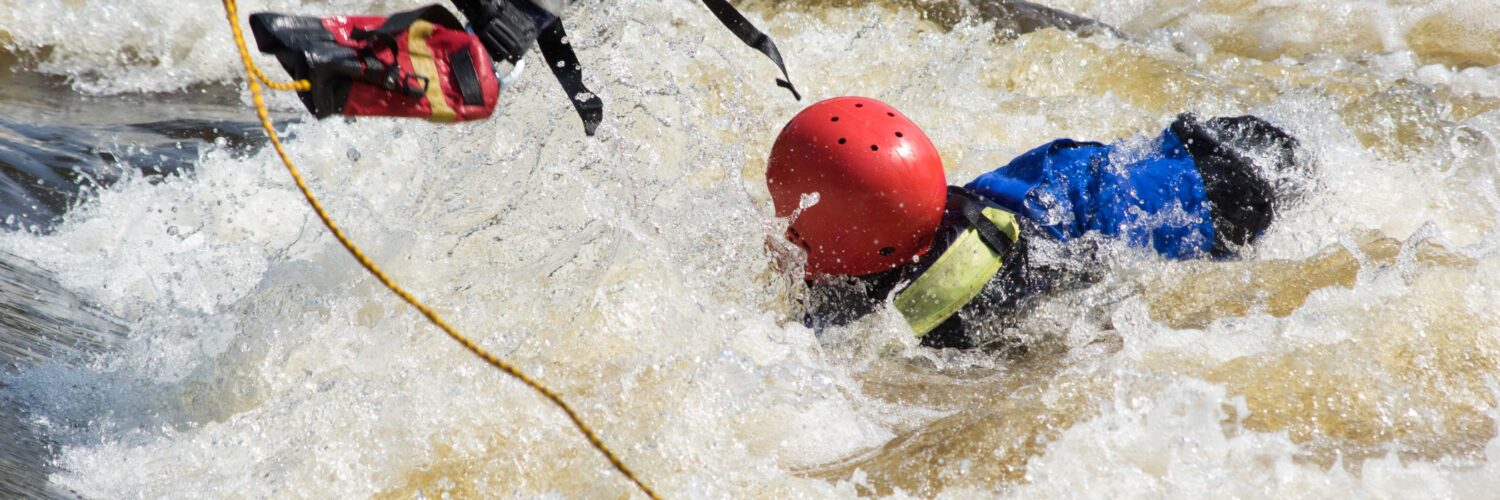
As water flows over the face of the weir there is the potential to create a ‘re-circulation’ feature on the downstream side when surface water is pulled back into the face of the weir. Whilst we commonly have two names (weir and low head dam) to describe these structures, there are many more words used to describe this re-circulation including hydraulic, hydraulic jump, hole, stopper etc. Depending on the strength of the recirculation it can have the ability to trap floating debris, objects, equipment and potentially people.
The same re-circulation features can be found on the downstream side of natural river features and these can also provide significant risk, however being natural features there is often a point of weakness that allows trapped objects/people to be flushed out. With man-made weirs we have the potential to combine the ability to generate very strong and deep recirculation with the uniform, smooth surfaces of a man-made structure which may not have any points of weakness in the recirculation, thus making it difficult if not impossible for anyone who becomes trapped in the re-circulation to escape.
That said not every weir creates dangerous re-circulation features and even those that do, may not have these features present at all water levels. For example, consider a weir that at medium water levels has a significant re-circulation. If water levels are reduced (summer flows, after periods of low rainfall etc) then the amount of water flowing over the weir could be significantly reduced which in turn could reduce the size and strength of the re-circulation. Equally, when the river level rises, and we are in high flow/flood conditions, there is potential for water flowing over the weir to effectively ‘drown’ the structure so that it disappears under the water and the surface recirculation disappears. From this example we can see that the level of hazard and risk created by a weir can vary with water levels so if we want to risk assess a weir, we need to do this at a range of water flows to gain a complete profile. I will look at weir risk assessment in more detail in part two of this feature.
Weir hydrology
An understanding of the basic hydrology of weirs will allow us to appreciate the nature of the re-circulation hazard they can present. As water falls over the face of the weir it will create a low-pressure effect which causes the surface water on the downstream side of the weir to flow upstream towards the weir face. This is the same kind of effect that creates the upstream flow of water in an eddy as the main current flows past the obstacle creating the eddy.
This surface water flowing back upstream towards the weir face is known as ‘tow back’ and if this is of sufficient size and strength can cause floating objects to be trapped in the weir.
The main water flow over the weir face will flow to the base of the weir and whilst some will continue flowing downstream, much of this water can flow up to the surface on the downstream side of the weir creating a distinct ‘boil line’ where it reappears on the surface . Some of the water returning to the surface at the boil line will feed into the surface tow back flowing upstream to the weir face, whilst the remainder will move downstream from the boil line and is commonly called the ‘out wash’.
How powerful the recirculation hazard will be on any given weir will be a result of the relative strengths and depths of the various waterflows as described above and these will change relative to the amount of water flowing over the weir.
The design of the channel bed at the base of the weir is one of the key determining features as to whether a weir will have a significant re-circulation hazard. Many modern weir designs will have a ‘stilling basin’ on the downstream side of the weir face. This is a trough like feature which has the effect of increasing the amount of water flowing to the surface at the boil line and the size and extent of the tow back. Natural ‘Stilling basins’ can be created by the depositing of stones and boulders a short distance after the weir but man-made basins can have an artificially long apron making it possible for the boil line to be a significant distance downstream of the weir face with the surface tow back flowing upstream from the boil line to the face of the weir.
Why do we have weirs?
Weirs have been constructed for hundreds if not thousands of years and for a wide variety of reasons. The raised level of water on the upstream side of the weir are commonly used for ensuring water availability to divert flows into locks and mills etc. More recently weirs are commonly constructed for channel stabilization/erosion control, water flow measurement and aiding fish passage.
Steeper channels with increased water velocity have great ability to erode the banks and channel bed. By constructing a number of weirs, it is possible to create a series of engineered drops with low energy water between the weirs thus reducing the potential for channel erosion.
Weir risks
To the unaware, many weirs can appear very benign structures. The combination of slow-moving flat water above the weir, a smooth weir face and relatively slow-moving water downstream of the weir can cause many people to underestimate the power and retentiveness of the weir. There are unfortunately numerous examples of where people have entered weirs due to a lack of understanding of the risk they present often with tragic consequences. Particular examples I am aware of include members of the public jumping into weirs in an effort to rescue dogs which entered the weir to fetch floating debris, commercial rafts which failed to make the ‘take-out’ eddy above the weir and water rescue teams in powerboats accidentally crossing the boil line and being taken into the weir by tow back both in training exercises and rescue call outs.
As rescuers called to a person trapped in a weir, much of the weir risk assessment has been done for you by the victim. The very fact that they are trapped in the weir tells us a lot about the nature of the weir and the risks it presents to us as rescuers. We have the same set of rescue techniques available to us as for other swiftwater and flood rescues, but we need to decide if they are applicable to the weir we are faced with and if so whether we need to adapt them to this purpose.
Weir rescue options
Bank-based reach and throw options
We can separate the variety of rescue techniques available to swiftwater and flood rescuers into two categories; conditional rescues and true rescues.
- A ‘conditional rescue‘ technique is one that requires the victim to actively take part in their rescue and if they fail to do so the rescue will not work e.g. throwing a throwline to a casualty in the water is totally conditional upon their ability to hold onto the rope that has been thrown to them. If they are unable or unwilling to do this the rescue fails regard less of how good the rescuer is at throwing throwlines!
- A ‘true rescue‘ technique does not require any input from the casualty. Thus, the success of a tethered swim rescue is all about the ability and skill of the rescue team and does not rely on the casualty’s input.
All the variety of bank-based reach and throw options (eg. throwlines, reach poles, inflated fire hose) are conditional rescues and rely on the victim’s ability to hold onto the rope etc. This can be very difficult to do when trapped in a weir and therefore other ‘true’ rescue options will probably need to be utilised. That said, there are great benefits to throwing floating objects to anyone trapped in a weir to hold onto as the added buoyancy they provide will help them stay at the surface.
Downstream backup
Even though the focus is on a person trapped in the weir we need to ensure that we are still putting in as effective downstream backup as possible. It is possible that the trapped person might be washed out of the weir and we need to be able to rescue them if this happens. Having just spent time trapped in the weir it is very unlikely that they will be able to assist in their own rescue, so we really need downstream back up to be a ‘true’ rescue option – contact swim, boat etc
Adapting tethered boat techniques to weirs
When operating around weirs we need to appreciate how the current forces and risks might have altered as compared to a normal channel-based rescue. Tethered boat rescues are a potential choice for weir rescues whether we’re using the tether lines to keep the boat downstream of the boil line or to allow us to hold the boat over the boil line and in the tow back. When tethering boats in a normal channel we look to use multiple points connected with a load distributing anchor system on the boat for each upstream tether rope as they will see the greatest load and we do not want one of the lines to fail. As the downstream tether ropes will see less loading, we will commonly just clip these to a single attachment on the boat as failure here would be less consequential. However, when working on the downstream side of a weir it is now the downstream lines that are critical in stopping the boat being moved upstream by the tow back. Consequently, we need to now rig these, so they are attached to at least two points on the boat with a load distributing anchor.
Boat on a highline systems
The ability to control boat position and deal with larger water forces that we get from boat-on-a-highline systems are ideally suited to some weirs. These systems need to be pre-planned and trained for or else they are slow to set up and complicated to operate smoothly.
Commonly, boat-on-a-highline systems are rigged with the trackline on the upstream side so that the main control rope to the boat (reeving line) is used to control/move the boat against the river flow. With weirs it is not uncommon for the force of the tow back to be greater than the river flow both upstream and downstream of the weir so consideration should be given to either positioning the track line downstream of the weir rather than on the upstream side. BOAH systems can be quite complex to set up, rescuer-intensive and requires excel lent communications between all rescuers. The main control/reeving rope can be used to control the boat from entering the weir or to hold the boat on the tow back and means it is easier to recover the boat from the weir. Downstream track lines are also of particular use on weirs with high vertical faces.
Once the distance across the weir becomes too great to effectively manage ropes then tethered boat, including boat on a highline systems are no longer suitable. Rescues using powered boat and helicopters are still potential options to consider.
Powered boat rescues
Operating around weirs in powered boats requires a high level of experience and skill from the boat operators and an understanding of the hazard the weir can present. There are numerous examples of crews crossing the boil line (both intentionally and unintentionally) from the downstream side of a weir without realising the effect this would have on their boat, only to find the boat being carried into the face of the weir by the tow back and potentially capsized. Propellers are much less effective in the aerated water of the tow back so the ability to use the engines drive to avoid the weir once over the boil line is greatly diminished.
Powerboats operating downstream of a weir to put in place effective ‘true’ downstream back up should anyone be washed out of the weir are highly beneficial if water conditions allow for their use. However, the closer we operate to the weir the greater the risk of entering the weir. There are techniques for ‘tandem’ boat operations where boats are connected by rope with the idea being that the downstream boat can prevent the upstream boat from being carried over the boil line into the weir. Such techniques require extensive levels of relevant training and as well as being highly trained in their use, if boat crews are to use these techniques, they need to ensure the potential benefits are in proportion to the operational risks.
Helicopters and cranes and hydraulic ladders
Helicopters have the most obvious potential to position a rescuer immediately above the tow back of the weir so the rescuer can make contact with the victim in the weir and either lift them from the weir or pull them through the water to the downstream of the boil line. The same might be true of a nearby construction as was seen on the Des Moines River in Iowa, USA in 2009. It may also be true of fire service hydraulic ladder/platforms used for high-rise incidents and fires. Some have the ability to operate at very low and even reverse angles but such operations require a very clear understanding of the load capabilities which diminish massively with decreased angle and greater extension. There are many photos and YouTube videos showing how easy it is to overload a boom arm, whether it be a crane or an HP/ALP so such measures will normally be a last resort. Nevertheless, as soon as a report of a person trapped in a weir is received by the emergency services, in addition to the water rescue team(s), rescue helicopter and pre-approved hydraulic ladder/platform deployment should be considered if available. If, on arrival of the rescue teams at the weir they can deal with the situation, the larger assets can then be stood down. If decisions on alternative tasking are left until arrival on scene or after failure of initial rescue attempts, then launch and travel time for the helicopter/large vehicle may mean it arrives on scene too late.
Relevant training
As seen above, the full range of swiftwater rescue techniques are potentially applicable to weir rescues, but their use needs to be determined by a process of risk/benefit assessment. Whilst there are weirs where it would be suitable to perform a contact swim rescue or place a raft over the boil line to perform a rescue, there are others where such options would result in an unacceptable level of risk to the rescuers. Weir rescue needs to be pre-planned for and through this process, we need to ensure that we have the required capability, personnel, equipment and training to carry out the rescue techniques most appropriate to that weir. The time to determine which techniques are appropriate is on a training session following a suitable risk assessment, as opposed to waiting for an incident to occur at the weir and trying to work out what to do at that point. The ability to risk assess the hazard of a weir is essential if we are to conduct training and operational rescues from weirs, and I will look at this process in part two.
 Paul O’Sullivan is the Managing Director of R3 Safety and Rescue – specialist rescue training and equipment supply business based in North Wales, UK. He’s been delivering swiftwater and flood rescue training for over 20 years and teaching Rescues from Vehicles in Water classes since 2004. He sits on the UK’s National Fire Chief’s Council Inland Water Technical Response Group.
This article originally appeared in Technical Rescue Magazine, and is reproduced with permission from the author.
Published: 06th Oct 2021