Weirs and Low Head Dams – A Guide For Rescuers – Part 2
It would appear that a common theme associated with incidents involving weirs is an underestimation of the danger and entrapment potential of the weirs. This applies to both members of the public, emergency responders and professional river users such as white water rafting companies.
In part one of this series I looked at different types of weirs and options for conducting rescues from weirs. In this article I will move on to consider how we can use a weir assessment system to help inform our understanding of the hazard level of a weir and the difficulty of performing a rescue of a person trapped in a weir.
Following a fatality in a North Wales weir in 2005 it was identified that there was a need to develop a tool that would allow the hazard level presented by entrapment in a weir to be assessed. The result of this is the Rescue 3 Europe/Natural Resources Wales Weir Risk Assessment which I co-designed. This has been in use now for over 10 years and adopted by many organisations in both Europe and North America and has proven to be a very useful resources for determining hazard and risk levels presented by weirs. As a rescue trainer, I was particularly interested in the risks and difficulties of undertaking rescues from weirs, so in addition to assessing the entrapment potential of a weir, the tool can also be used to assess rescue difficulty. Once we started trialling the assessment, we were asked if we could include a process to assess the public safety risk presented by a weir and this was also incorporated into the tool, so we ended up with an assessment tool with 3 possible uses:
The assessment tool can be downloaded from the Rescue 3 Europe website and is currently available in English, French, German, Italian, Spanish, Greek and Croatian.
Dealing with water level changes
Not all weirs will present an entrapment hazard and many of those that do will not have the same level of hazard across all water levels, If we use the tool to assess a weir we are only determining an entrapment hazard etc. at that water level. If we wish to develop a hazard/risk profile for the weir then we need to assess the weir at a number of water levels and I would suggest a minimum of three assessments to correspond with low, medium and high flow conditions.
Assessing entrapment hazards
Similar to how a kayaker will ‘read’ the surface features of a white water river to determine the hazards and best route through a rapid, we can use the visible features of a weir to determine its potential to retain a person who ends up in the weir. There is no single criteria that will ensure entrapment, but rather we need to look at a number of criteria and use these to develop an overall level of entrapment hazard. Not all criteria are given equal weighting when determining the entrapment hazard. For example the distance of the towback on the downstream side of the weir, which is a key entrapment indicator, is scored between 0 and 5, whilst the orientation of the weir to the flow is only scored between 1 and 3. A score of zero is given if that particular criteria is not present. If in high flow conditions the weir is totally submerged and there is no entrapment hazard then the assessment tool will give a hazard score of zero.
The criteria used to assess entrapment hazard are:
1. Towback
This is the surface water on the downstream side of the weir moving back upstream towards the weir face and is a key criteria for determining the entrapment hazard of the weir. It is measured as the horizontal distance from the boil line downstream of the weir back to the bottom of the face of the weir.
2. Depth of hydraulic/stopper
In some weirs the energy of the water creating the downstream boil line results in an elevated boil line. This will mean that the towback is faster and increases the entrapment potential. We measure the vertical height from the top of the boil line to where the tow back meets the base of the weir face. In practice this is probably one of the most difficult criteria to measure as there are often few reference features to measure against, particularly on larger weirs and those with high channel banks.
3. Height of the drop over the weir
The greater the drop over the weir the larger the energy being carried into the weir. If there is low energy (speed) water immediately downstream of the weir it means that the energy is being dissipated in the weir. Some of this can take the form of noise and spray etc, but often the majority is dissipated through strong, deep recirculation with the associated entrapment potential. This is measured as the vertical distance from the river level immediately upstream of the weir to where the towback meets the base of the weir face
4. Slope of the weir face
In a similar way to the previous criteria the more vertical the face of the weir the greater energy being carried into the weir. This is measured by estimating the angle between the weir face and vertical – the steeper the face of the weir the greater the score allocated for this criteria.
5. Floating debris in the hydraulic/stopper
Floating debris being held in the weir is a key indicator of the entrapment potential of a weir. Even if a weir has a large towback and elevated boil line it is unlikely to retain floating debris if there
are weaknesses/breaks in the hydraulic where it can wash out. The size and weight of the debris will also give some indication of the strength of the hydraulic and its associated entrapment potential. However, we must also be open to the fact that a weir may have the potential to hold floating debris, but is not doing so only because there is no floating debris currently present . This could be the result of recent high flow conditions which reduced the recirculation of the weir and caused all the floating debris to be washed downstream. To score this aspect we look at how much of the weir is retaining floating debris as a percentage of the whole width of the weir. Non floating debris in the weir e.g a large tree that has been carried downstream and is now resting on the base of the weir is not scored in this criteria as it is not indicative of the entrapment potential. It is obviously a hazard to anyone in the weir and is covered when assessing criteria 9 – Additional hazards in or downstream of the weir.
6. Uniformity of the hydraulic/stopper
With this we are looking for weaknesses/breaks (flush points) in the hydraulic/stopper where any floating objects trapped in the weir could be washed out downstream. If the hydraulic/stopper
is completely uniform with no weaknesses then the only route out of the weir is likely to be being recirculated in the water to the base of the weir and then hopefully being carried downstream when this water returns to the surface at the boil line.
7. Sides of the hydraulic/stopper
Here we are looking at what happens at the sides of the weir. If a trapped person swims or is taken by the recirculation to the side of the weir – is that side ‘open’ or ‘closed’. An open side will increase the possibility for self-rescue, being washed out or being rescued from the weir. If the sides of the weir are closed e.g vertical concrete walls then the entrapment hazard is obviously greater. It is worth noting that some weir sides that appear to be ‘open’ can be ‘closed’ by recirculating eddy currents flowing towards the weir.
8. Orientation of the hydraulic/stopper to the flow
With this criteria we are measuring the angle between the current vector (the direction of flow in the channel at that point,) and the face of the weir. If the weir is 90 degrees to the current vector there is unlikely to be any general water movement toward the downstream end which could cause anything trapped in the weir to be carried to this downstream end. The shallower the angle between the weir and the current vector the greater the potential for this downstream movement.
9. Additional hazards in or downstream of the weir
Here we are looking for additional hazards either in or downstream of the weir and if a hazard is present whether it is in the main flow and likely to affect a person held in or being washed out of the weir. Common hazards include multiple weirs where should a person be washed out of a weir they are then carried into another downstream weir or weirs. Similarly, a weir immediately upstream of a difficult rapid or in-water strainer would present a greater hazard to a person being washed out of the weir as compared to a slow moving clear channel on the downstream side of the weir.
10. Composition of the riverbed at the base of the weir
Weirs can be made of a variety of materials all of which have varying potentials to erode and provide additional entrapment or impact injury to a person being held in the weir recirculation.
Once we have scored the above 10 criteria we will have a number between 0 and 40 which represents the weir entrapment hazard for the water level when the assessment was undertaken. To help compare and communicate this, the assessment tool provides five hazard bands which describe the hazard level from Very Low (1) through to Very High (5).
By revisiting the weir over a variety of water flow levels we can then begin to develop a profile of how the entrapment hazard of that weir changes with different flow conditions.
Assessing rescue difficulty
The assessment of rescue difficulty from a weir is based on the assumption that a person is being held in the weir by the stopper/hydraulic. The very fact that we have a person trapped in the weir is highly indicative of the hazard level of the weir and its potential to cause harm to rescuers. We assess the difficulty of rescue from the weir by looking at a number of criteria and scoring each of these in a similar way to how we calculated the entrapment hazard. As many of these criteria are based on the location and structure surrounding the weir there is likely to be a much smaller level of variation in the scores obtained for rescue difficulty across a range of water levels.
The ten criteria used are:
1. Distance across the weir/river
The further the distance between our working areas on both banks the more difficult it will be to communicate and operate twin bank systems etc. e.g. tethered boats/boat on a highline.
2. Access to both banks
It might not be possible to gain access to both banks and if this is the case it will restrict the rescue options available. When assessing access, we look at whether we have access for vehicles and people, people only or no access to each bank. More complex weirs with in-channel walls can mean that there is effectively no bank access should someone become held in the section of the weir between these mid channel walls.
3. Shape of the weir
The shape of the weir can determine how well some rescue techniques can be applied. Straight weirs tend to allow for easier application of in-water reach techniques e.g inflated fire hose and tethered boat options.
4. Towback
We have already considered the towback distance from the boil line to the base of the weir face as a key criteria for determining entrapment hazards, but it must also be considered when
looking at rescue difficulty. One decision to be made when choosing rescue option is whether we can put a rescuer or tethered boat etc. into/on the towback. Extensive towback with an elevated boil line will increase the hazard level of operating inside the tow back. Also, the greater the distance of the towback the more difficult it is to perform a true rescue from downstream of the boil line.
5. Remoteness
This criteria looks at finding, accessing and resourcing rescue operations at the weir and the more remote the weir location is the greater the allocated score.
6. Nature of the river downstream of the weir
Whilst the nature of the weir is key in determining rescue options available, so is the nature of the river downstream of the weir. This can vary from slow moving shallow water to difficult rapids, with probably the worst case being more retentive weirs downstream of the rescue scene. The nature of the river downstream will determine what techniques and equipment can be deployed downstream of the weir both for performing the rescue as well as providing downstream backup for the rescue.
7. Working area on both banks
In criteria 2 we looked at if we had access to both banks. This criteria now looks at whether we have a suitable working area on each bank that allows us to set up and operate a rescue from that location.
8. Anchors for rope system
There are a number of rope-based rescue options available which may be suitable for a weir rescue including 4 point tethers, boat on a high line and overhead high line rope systems. This criteria assesses whether we have suitable anchor systems on each bank to set up these systems.
9. Available rescue techniques
This is scored on the range of rescue options that could be used at the weir. Some weirs will allow for a full range of single and bank-based techniques to be used including placing rescues/
boats in/on the towback, whilst others, due to their size and level of hazard, might exclude all techniques other then use of a helicopter or overhead highline rope system. Even helicopter rescue might not be an option if there are overhead cables, bridges and other hazards to an aerial approach.
10. Height of the banks above the stopper/hydraulic
The higher the banks are above the weir the more difficult it is to access the weir and the greater the difficulty to recover a victim from the weir up onto the banks, particularly if we have
very steep banks or walls at either side of the weir.
Once all the criteria are assessed we can add them up to give a number between 7 and 43. Depending upon the score it can be allocated to three bands to describe the rescue difficulty at the
weir as low, medium or high.
Assessing weir risk (to members of the public)
Risk can be defined as the likelihood or chance of a particular level of harm occurring. We have already seen how we can assess the entrapment hazard of a weir, so to be able to determine the level of risk it presents we need to assess the likelihood of somebody entering the weir from both the banks or the river. To achieve this the weir is considered as four quarters- upstream river left, upstream river right, downstream river left and downstream river right.
For each of these sections we assess the following:
- Is there public access to this area by land or river?
- Are there any exisnng control measures in place to prevent people entering the weir e.g. fences, booms etc.?
- Ability to self-rescue – taking into account the existing control measures if someone fell in the river beyond the control measures could they potentially self-rescue before they entered the weir or would they be washed away from the weir rather than into the weir.
Once scored, the above criteria will give a score between 0 and 5 which will fit into 5 categories describing the likelihood of a person entering the weir ranging from Very Unlikely (1) through to Almost Certain (5). We can then use a standard 5 x 5 risk matrix to multiply the weir entrapment hazards score and the likelihood score to calculate the risk presented to members of the public by the weir.
Uses of the risk assessment tool
Weirs are permanent structures creating a particular risk in a known location. It is good practice for rescue organisations who might be required to respond to the weir to develop a pre-plan. The weir risk assessment tool can be utilised to understand the entrapment hazard of the weir at different flow levels as well as assessing the difficulty of rescue. This in turn can inform decisions on additional capabilities and equipment that might be needed. The weir risk to members of the public can be utilised to assess the benefit of existing control measures around the weir and potentially highlight improvements that would reduce the need to perform rescues from the weir. If we’re going to undertake rescues from weirs then we need to be training for these in as relevant an environment as possible which is ideally in a weir. The weir entrapment hazard assessment can be used to identify which weirs are suitable for undertaking training on and at which flow levels. Decisions made as to when we can train on a weir and what techniques are possible will directly inform decisions should an actual rescue subsequently need to be performed at the weir. Whilst its primary use is as a pre-planning tool the risk assessment does have a role at an actual incident -particularly if it’s a first time response to a weir that has not had any prior risk assessment undertaken.
For organisations that own and manage weirs, both the entrapment hazard assessment and weir risk assessment are useful tools to help make decisions about which weirs present the greatest hazard and public risk. Following the 2005 drowning in Weir X, which was the starting point for the development of the weir risk assessment tool, it was used to highlight the level of risk presented to the public by the weir which contributed to the decision to have the weir re-designed. The re-design ensured that whilst it still performs its required function to measure water flow down the river it no longer presents an entrapment hazard.
Worked example
Cromwell Weir is on the River Trent in Nottinghamshire, UK, and the former Weir X is on the Afon Tryweryn in North Wales, UK. These are very different structures. Indeed, perhaps the only two similarities are that they are both weirs and have both caused fatalities (multiple fatalities for Cromwell Weir).

Cromwell Weir is a large curved structure, approximately 100m wide, spanning the River Trent adjacent to a navigation lock, in a remote setting in rural Nottinghamshire. There is extensive towback that I’ve measured at over 14 metres. In addition to an upstream channel boom and warning signs, there is a memorial plaque on the bank for 10 soldiers who drowned in the weir in 1975 when undertaking a paddle boat exercise at night. Unfortunately, since then, there have been further incidents including the death of a fisherman in 2012.
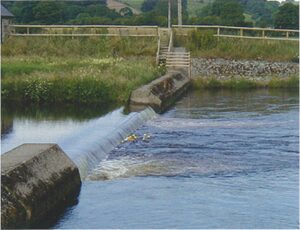
The former Weir X was a much smaller structure in the town of Bala, North Wales. It was on the River Tryweryn, which is dam-released, and regularly would be running during the summer, when it’s used to top up the level of the River Dee. Situated just downstream of the main carpark in the town and with a popular footpath running alongside, it was much more open to human interaction than Cromwell Weir. The weir itself was very insignificant-looking with a drop of less than 50cm and slow-moving water both upstream and downstream of the weir. Without undertaking a full weir risk assessment, the only indication as to the strength of the weir’s recirculation was the collection of tennis balls, sticks etc that would often be held against the face of the weir by the towback.
When we assess both weirs for entrapment hazard, we get the following:
| Cromwell Weir | Former Weir X | |
| Entrapment hazard score | 28 | 26 |
| Entrapment hazard level | High (4) | High (4) |
The fact that both are high risk and there is little difference between the actual scores might seem surprising at first. However, both structures have enough towback to get the maximum allocation for that criteria and in both cases the stopper/hydraulic is uniform with no breaks and has the potential to hold floating debris. Both structures are at 90 degrees to the current vector and have vertical or near vertical weir faces. Weir X has a much smaller height which is largely explains the difference in hazard scores between the two weirs. With large concrete walls the sides of Cromwell Weir are clearly ‘closed’ whereas the sides of Weir X appear to be open. Closer inspection however showed that the large downstream eddies at both sides of the weir have strong eddy currents flowing back towards the weir which effectively ‘close’ both sides of the weir.
Neither weir has a highly elevated boil line and there are no additional hazards downstream which explains why neither make it into the ‘Very High’ category for entrapment hazard.
When we assess both weirs for Rescue Difficulty we get very different results:
| Cromwell Weir | Former Weir X | |
| Entrapment hazard score | 33 | 16 |
| Entrapment hazard level | High | Low |
- The large width of Cromwell Weir is too much to operate tethered boats.
- Greatly reduces the potential for any bank-based conditional rescues to be successful.
- The combination of river width and a large powerful recirculation pretty much rules out any tethered swimmer options.
- Powerboat operations below the weir are unlikely to provide a true rescue capability from the weir.
- Helicopter would seem to be the only effective solution, and there are no overhead obstructions to prevent its use.
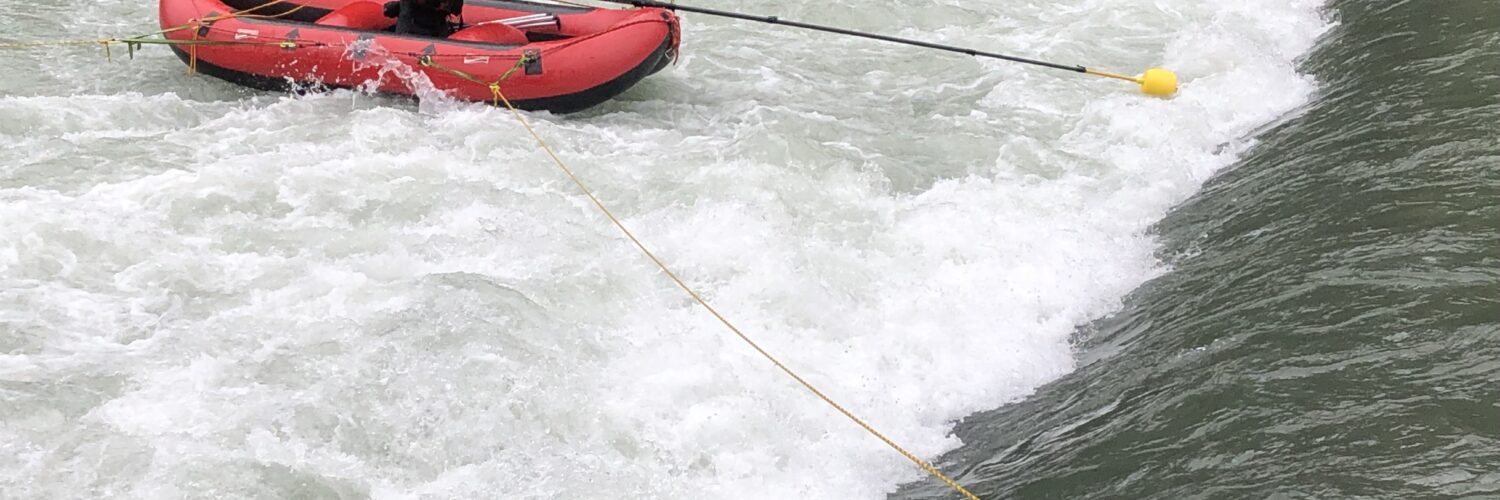
The former Weir X by contrast had a wide variety of rescue options available. The narrow river channel allowed for both reach and throw conditional rescues to be undertaken if the victim was able to hold onto these. Whilst the entrapment hazard has proven to be lethal, a properly trained and equipped rescuer can perform tethered swim rescues from the weir and a variety of tethered boat operations can be performed with the boat able to cross the boil line and onto the towback in a controlled and stable way.
We can therefore see that whilst both weirs present a similar level of entrapment hazard there are significant difference in the rescue difficulty.
In terms of risk presented by the weirs to members of the public, including river users, Weir X sees much more public access. The main potential interaction with Cromwell Weir would be from boats navigating the Trent and using the lock adjacent to the weir. There is a large boom across the river upstream of the weir located just below the lock entrance but no boom on the downstream side.
When we undertake the Weir Risk Assessment we get the following outcomes for each weir:
| Cromwell Weir | Former Weir X | |
| Entrapment hazard score | 28 | 26 |
| Entrapment hazard level | High (4) | High (4) |
| Likelihood of causing harm score | 2 | 3 |
| Likelihood of causing harm level | Unlikely (2) | Likely (3) |
| Weir risk score | 8 | 12 |
| Weir risk level | Medium | High |
The combination of a ‘high’ entrapment hazard and a location that means it’s ‘likely’ to cause harm to members of the public results in a ‘high’ weir risk level for Weir X. Whilst Cromwell
Weir scores ‘unlikely’ in terms of whether it will cause harm to members of the public the fact that the risk of entrapment is ‘high’ results in it having and overall risk level of ‘medium’.
 Paul O’Sullivan is the Managing Director of R3 Safety and Rescue – specialist rescue training and equipment supply business based in North Wales, UK. He’s been delivering swiftwater and flood rescue training for over 20 years and teaching Rescues from Vehicles in Water classes since 2004. He sits on the UK’s National Fire Chief’s Council Inland Water Technical Response Group.
This article originally appeared in Technical Rescue Magazine, and is reproduced with permission from the author.
Published: 06th Oct 2021