Defra modules of Rescue 3 training courses
Defra Module |
Defra title and description |
Rescue 3 Europe course |
| Module 1 | Water & Flood Awareness
General water safety awareness training |
Water and Flood Awareness (AW) |
| Module 2 | Water & Flood First Responder
To work safely near and in water, using land-based and wading techniques |
Swiftwater and Flood First Responder (SFR) |
| Module 3 | Water & Flood Rescue Technician
Specialist rescue operation |
Swiftwater and Flood Rescue Technician (SRT) |
| Module 4 | Water & Flood Rescue Boat Operator
Rescue boat operations |
Swiftwater & Flood Rescue Boat Operator (SFRBO) |
| Team Commander | Asset Commander
Water team related incident command |
Water and Flood Team Leader (WFTL) |
| Module 5 | Water & Flood Incident Management
Water-related operational and tactical incident command |
Management of Water and Flood Incidents (MWFI) |
| Module 6 | Flood Rescue Tactical Advisor Provide advice to tactical and strategic commanders and credentialing. |
|
| Water and flood non-rescue support operations training module (Annex G) |
Water and flood non-rescue support operations training module
Workers and volunteers who work in support of flood response but do not come from rescue organisations. |
Flood Operations – Foundation (FO-F)
or |
See also Alternatives to ‘Defra courses’ for industrial working in and near water
Using the ‘Rescue 3 accredited’ logo
What is the ‘Rescue 3 accredited’ logo?
The ‘Rescue 3 accredited’ logo shows that an organisation or individual currently holds a Rescue 3 qualification.
Rescue 3 training courses are delivered by approved Rescue 3 training providers, according to the Rescue 3 course standards. Each student completes an individually-numbered skill sheet (training log), which is logged and checked in the Rescue 3 training provider database. Certificates are then issued to those students.
Who can use the ‘Rescue 3 accredited’ logo?
Any organisation or individual who has in-date Rescue 3 students may display the ‘Rescue 3 accredited’ logo on their website.
There are currently more than 60,000 in-date Rescue 3 students worldwide, from more than 4,000 different organisations. There are more than 300 Rescue 3 training providers, delivering over 3,500 Rescue 3 courses worldwide every year.
Any of these people or their organisations may choose to use the ‘Rescue 3 accredited’ logo.
If you place it on your website, we ask that you please link the image to www.rescue3europe.com (Europe) or www.rescue3.com (rest of the world).
Where can I download the Rescue 3 accredited logo?
Here! It’s available in two colour schemes, and in JPG, PNG (transparent background and filled background) and PDF format. If you require it in another image format, please Contact Us.
Blue and red, on white
JPG
PNG (transparent)
PNG (fill)
PDF
White and red, on black
JPG
PNG (transparent)
PNG (fill)
PDF
Where can I use the ‘Rescue 3 accredited’ logo?
Anywhere that you are accurately reflecting your relationship to Rescue 3.
This includes, but is not limited to:
- Websites
- Email signatures
- Signs
- Displays
- Other marketing materials
- PPE and equipment
- Vehicles
If you wish to get a tattoo of the logo, please Contact Us first and we’ll try to talk you out of it. If there’s no discouraging you, we’ll at least try to persuade you to get a small tattoo on your upper arm, rather than a full face tattoo.
How can I check if someone is accredited by Rescue 3?
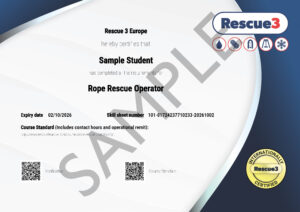
Every Rescue 3 student receives a PDF certificate by email upon completion of the course. These show their unique skill sheet number, and the qualification expiry date. They also include a QR code which can be used to check their authenticity.
A sample certificate is shown below. Certificates are available in more than 30 different languages, based upon the preferred language of the training provider and/or student, but they all follow the same format.
Students may also optionally purchase an ID card which has their photo, and a QR code that provides a live list of all their qualifications.
Use of the ‘accredited’ logo on its own doesn’t prove an in-date qualification. Always ask for a certificate or an ID card if verifying a qualification.
You can also contact the Rescue 3 head office to check the qualification details of any Rescue 3 training provider, instructor or student.
How long are Rescue 3 qualifications valid for?
All student-level Rescue 3 qualifications are valid for 3 years from the date of completion.
Rescue 3 instructors must recertify every 2 years.
How can I check if I’m receiving Rescue 3 training?
Rescue 3 training must be delivered by a Rescue 3 Training Provider using trained and in-date Rescue 3 instructors, and following the Rescue 3 course standards.
All students will fill in a Rescue 3 skill sheet, which the training provider logs in the Rescue 3 training provider database, and which is checked by Rescue 3.
At the end of the course, all students receive a PDF certificate by email.
If you haven’t received your certificate after the course, contact the training provider who delivered it to you in the first instance. If you still need help, you can contact Rescue 3 directly.
Which image formats is the ‘Rescue 3 accredited’ logo available in?
The ‘Rescue 3 accredited’ logo is available as .jpg, .png and .pdf files.
It’s available in two different colour schemes: blue and red on white, or white and red on black.
If you need it in another format, please get in touch – we may be able to help.
Can I change the ‘Rescue 3 accredited’ logo?
Basic resizing of the logo, so that it best fits the layout on your website? Sure! Please keep an eye on the aspect ratio though.
Please don’t add/remove text or images to the logo, change the colours, or make other changes to the logo.
What other Rescue 3 logos are there?



The Rescue 3 logo is used to refer to both Rescue 3 Europe and Rescue 3 International. Rescue 3 Europe is the accrediting body for all Rescue 3 training within Europe. Rescue 3 International is the accrediting body for all Rescue 3 training in the rest of the world (outside of Europe).
The above three logos must only be used with the express written permission of Rescue 3. (No written permission is needed for the ‘Rescue 3 accredited’ logo).
Only approved Rescue 3 training providers may use the ‘Rescue 3 Europe training provider’ or ‘Rescue 3 International training provider’ logo, depending on their jurisdiction. (See Become a Training Provider if you would like to become an approved training provider).
Rescue 3 skill sheets available in more than 30 languages
Rescue 3 qualifications are a global standard, and Rescue 3 courses often bring together people from a wide range of countries and cultures. In fact, a recent Rescue from Vehicles in Water (RVW) course delivered by Društvo reševalcev iz vode Slovenije had participants from 8 different countries: Slovenia, Austria, Italy, Bosnia and Herzegovina, Argentina, Chile, Georgia and Iran. That’s them in the picture up there!
It’s a wonderful side-benefit of our work that we get to bring people together like this, and we’re delighted to announce the latest step in this process. Rescue 3 Europe has undergone a major programme of translating its skill sheets into more than 30 languages, and these are now available for Rescue 3 training providers running courses.
Anyone who’s taken a Rescue 3 course will be familiar with skill sheets. Rescue 3’s skill sheets are a record of training which lists all the course content, correlating to the detailed Rescue 3 course standards. The skill sheet is signed by the student and instructor, and is logged within the Rescue 3 Training Provider Database as a record of Rescue 3 qualifications. There are more than 100 separate Rescue 3 courses available to meet the needs of an ever-expanding client base, each with its own skill sheet that’s generated dynamically by the Rescue 3 training provider database.
Rescue 3 training providers can now select their preferred language of choice for all courses that they deliver. They can also specify on a per-student basis which language they would like. So, using Društvo reševalcev iz vode Slovenije’s RVW course as an example, the training provider may have Slovenšcina (Slovenian) as their preferred language, but each student can receive their skill sheets in their preferred language – Deutsch (German), Italiano (Italian), босански (Bosnian), Español (Spanish), ქართული ენა (Georgian) and فارسی (Farsi), or from any of the other 30+ languages.

Rescue 3 is the world’s largest and most respected technical rescue accrediting body. Since 1979, Rescue 3 training has been delivered in more than 75 countries worldwide, to more than half a million students. There are currently about 300 Rescue 3 training providers worldwide. These training providers have about 2,500 instructors. Over the last 3 years, there have been more than 60,000 students taking Rescue 3 courses.
Rescue 3 manuals and field guides are already available in a number of languages, as are instructor resources including videos and PowerPoints. Some of these manuals and field guides are also available for members of the public to buy, including:
- Guide du Sauvetage en Eau Vive (fr)
- Handbuch Fließwasserretter (de)
- Ασφαλής εργασία μέσα και κοντά στο νερό (el)
- Veilig Werken Op Hoooogte en Het Redden Van Collega’s (nl)
- Guía de Campo de Rescate Acuático (es)
- Soccorso Fluviale Guida Pratica (it)
We’re delighted to be able to offer Rescue 3 skill sheets in each student’s language of choice – but this isn’t the end of our translation work. With our talented IT team, we’ve developed a flexible and powerful back end to the Rescue 3 training provider database, which enables further translations to be added simply and smoothly, regardless of language and character set. We will continue to work with existing and prospective Rescue 3 training providers to make available the languages and courses that their clients want. Further translations of other student and instructor resources are being actively worked on in Spanish, Italian, Dutch and Greek.
We particularly want to thank everyone who’s been involved in the translation process – both the professional translators, and the instructors/training providers. The language of technical rescue isn’t always the easiest to translate, but after plenty of checking, discussion and re-checking, we’re proud of the end result. Thank you!
Safety courses for film, TV and media production crew
Rescue 3 Europe now offers a suite of internationally accredited safety courses designed specifically for film, TV and media production teams and crew. Open dates are offered as well as closed courses for companies at a location to suit a production team.
Designed combining Rescue 3’s over forty years of experience developing and accrediting safety and technical rescue courses with training provider Adventure Consultancy Worldwide Limited’s proven track record working with production companies on film and TV shoots as location safety advisers, consultants, film fixers, logistics experts and production trainers. Clients include the BBC, Netflix, Discovery Channel, National Geographic, Disney, Sky, Warner Bros and Amazon Prime.
These tailored courses address the varied roles of production team members from researchers, production managers, producers/directors to camera operators, instilling confidence when researching, planning and working in different and potentially challenging location environments. Critically they teach what basic safe practices need to be implemented.
Participants gain an internationally recognised qualification valid for 3 years to add to their CVs. Whilst not negating the need for specialist off-site safety advisors in the different stages of production, candidates will gain the knowledge to assess potential shoot locations at the outset, potentially saving time and money on recces to unsuitable locations, as well as ensuring better logistical and safety planning for recces and shoots.
Health and safety and insurance company requirements are increasing around the safety of shoots, and a more qualified production team and crew is a clear advantage when assessing and working in potentially hazardous locations.
The syllabus’s deliver an understanding of safe systems of work, including risk assessments and other forms of pre-planning undertaken by off-site safety advisors. They also illustrate the realities of working on location with on-site safety cover, and the capabilities of the safety teams and the equipment they’ll be working with. Practical skills for working safely in complex environments, plus basic self-rescue, and techniques for rescuing a colleague are taught.
Rescue 3’s safety courses for production crew delivered by are available across a wide range of shoot environments:
Safe Working Near Water for Production Crew (SWNWPC) is a 1-day course, for production crew who need to work safely near water.
Safe Working In Water for Production Crew (SWIWPC) is a 2-day course, with a higher capability than the SWNWPC course, including elements of working in water, and basic techniques for rescuing a colleague.
Lifejacket Use for Production Crew (LJUPC) is a half-day course, looking specifically at lifejacket use, for example if production crew have existing water awareness training.
Safe Operating in Boats for Production Crew (SOBPC) is a 1-day course for helping production crew gain confidence as a passenger in a boat on flat or moving water, whilst undertaking their tasks related to filming.
 Outdoor Risk Management for Production Crew (ORMPC) is a 2-day course for production crew working in remote areas, upland terrain and/or unfamiliar terrain. The course enables them to identify hazards and give them basic skills to work safely and deal with incidents in these environments.
 Safe Working at Height for Production Crew (SWAHPC) is a 1-day course that gives production crew members the knowledge and skills to recognise height-related risks, and apply appropriate safe systems of work.
Safe Working on Ice for Production Crew (SWIPC) is a 2-day course, for production crew working on or near ice, including ice testing, safe travelling on ice, and self-rescue techniques.
Alternatives to ‘Defra courses’ for industrial working in and near water
Rescue 3 Europe and its training providers are often asked for a “Defra course”. Whilst Rescue 3’s courses for emergency responders and rescue teams are Defra compliant, a ‘Defra course’ isn’t always the best fit for an organisation. What are the other options for water safety training, particularly if they are EA, SEPA, NRW personnel, construction industry workers, or road and bridge maintenance workers?
Which course do I need?
Rescue 3 Europe has a wide range of water safety and rescue courses, tailored to a diverse range of different clients. Below is a simplified flowchart of some of these courses, to help you choose the right course for you.
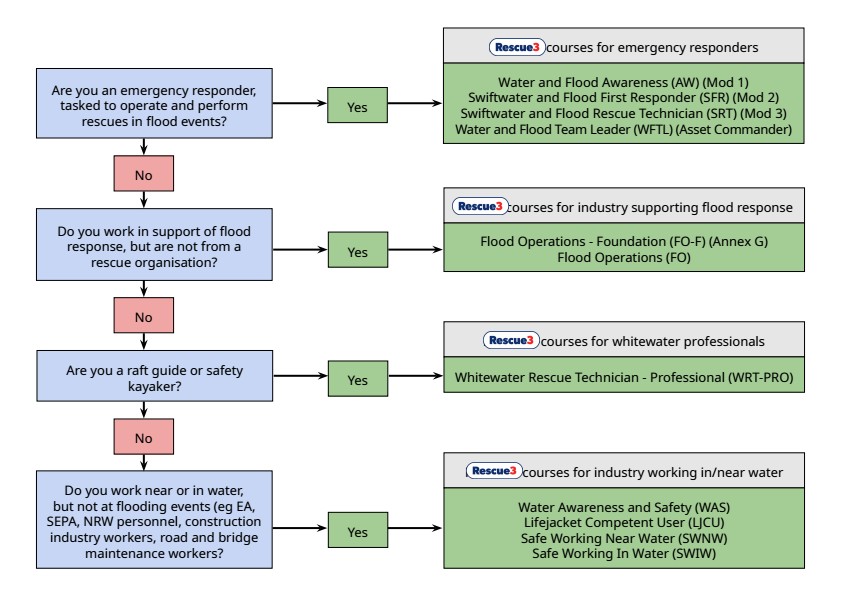
We will look in detail at the reasons why industry, construction and environmental planners and workers are usually better served by a Safe Working Near Water (SWNW) or Safe Working In Water (SWIW) course, and the other courses in the suite of courses for industry working in/near water.
Who is accrediting the course?
It’s worth noting that there’s no such thing as a ‘Defra course’. Defra isn’t an accrediting body for water rescue training. Water rescue training courses can be ‘Defra-compliant courses’, as Rescue 3 Europe’s suite of courses for emergency responders and rescue teams are. For these courses, Rescue 3 Europe is the accrediting body, with all that entails.
Defra compliance only means that a course conforms to criteria laid out by Defra, it doesn’t mean that Defra have in any way validated the course.
When you take a Defra-compliant Rescue 3 course, it’s Rescue 3 Europe who oversees that course, establishing best practice, setting and assessing criteria for training providers, instructors, students, and the courses they deliver/teach, as well as recording and monitoring all training records and incident reports within its world-leading training provider database.
If someone is selling you a ‘Defra course’, or more accurately a ‘Defra compliant course’, your questions should be:
“Am I tasked to operate in floods as part of a rescue asset?”
If you are not tasked to operate in floods as a rescue asset, or part of their support network, then a Defra-compliant course isn’t right for you, and you may want a course from the suite of courses for industry working in/near water.
“Who is providing the external accreditation of that course?”
For all our training providers, the answer to that question is Rescue 3 Europe.
What is the Flood Rescue Concept of Operations?
Defra’s Flood Rescue Concept of Operations (known colloquially as the ConOp or the FRCO) “sets out the processes for managing and maintaining flood rescue capability, and the national coordination of flood rescue assets in England”.
The original Defra ConOp was published in 2012. A revised version was published in 2019, and then again in 2025.
The ConOp covers many elements of operating in flood events, including the processes for registering as a national asset, and minimum equipment requirements for teams on the national asset register. A large proportion of the ConOp is given over to minimum training standards, and it is these that people are specifically referring to when they talk about a ‘Defra course’.
Who uses (and misuses) the Defra ConOp?
If we strictly interpret the scope of Defra’s Flood Rescue Concept of Operations (ConOp), it is specifically for flood rescue teams from England who are on the National Asset Register relating to flood event response.
However, in practice, it is also referred to by a number of organisations outside of its scope, including:
- Water/flood rescue teams from England who aren’t part of England’s National Asset Register.
- Flood rescue teams from other countries in the UK (Wales, Scotland and Northern Ireland).
- Flood rescue teams from other countries in Europe and the rest of the world who compare it with their own equivalent national/local frameworks.
- Flood rescue teams from other countries in Europe and the rest of the world where no such frameworks exist.
- People operating near and in water, but not responding to flood events, including raft guides, industry and infrastructure, environmental protection and monitoring organisations.

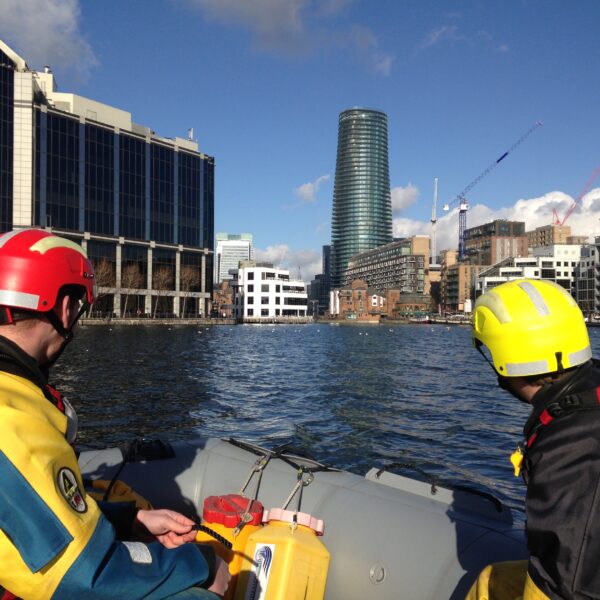
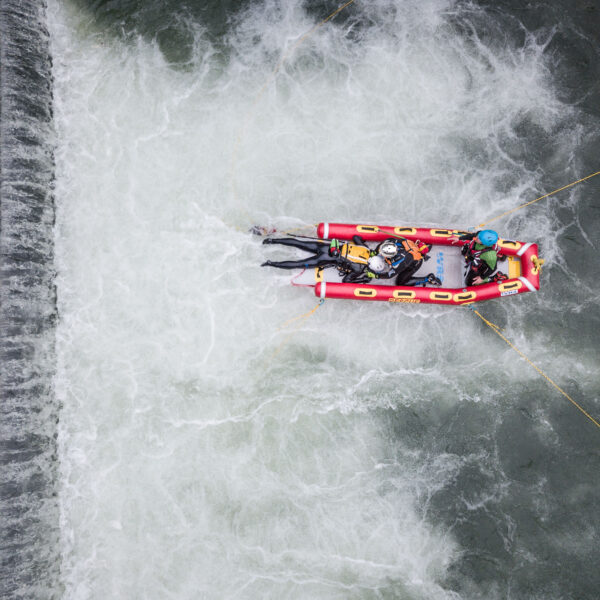

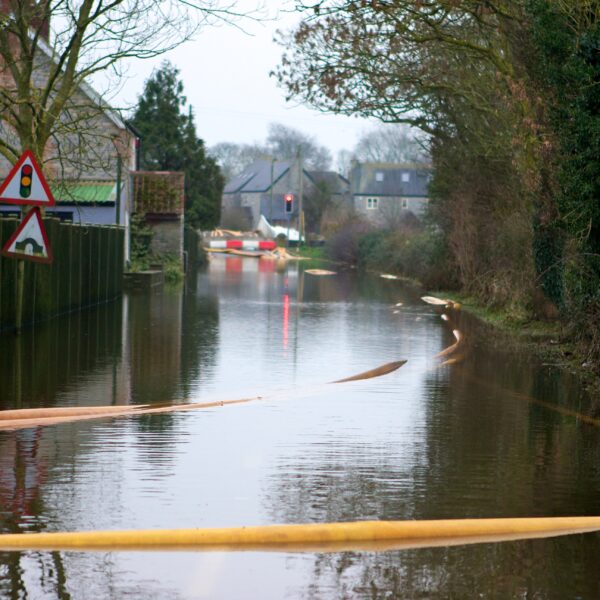

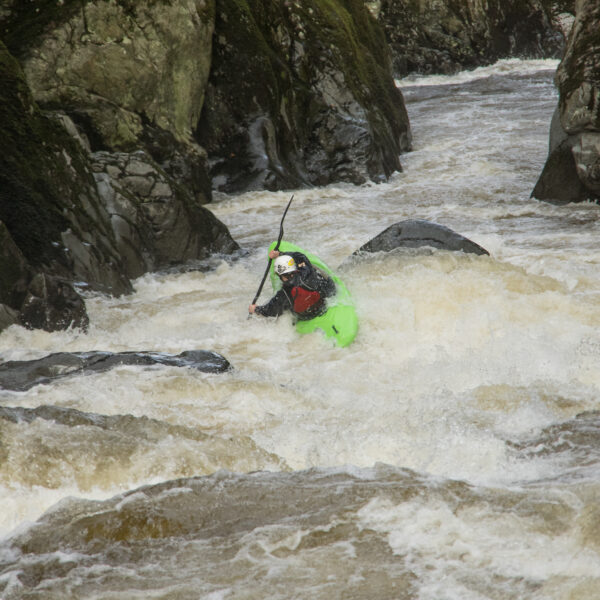
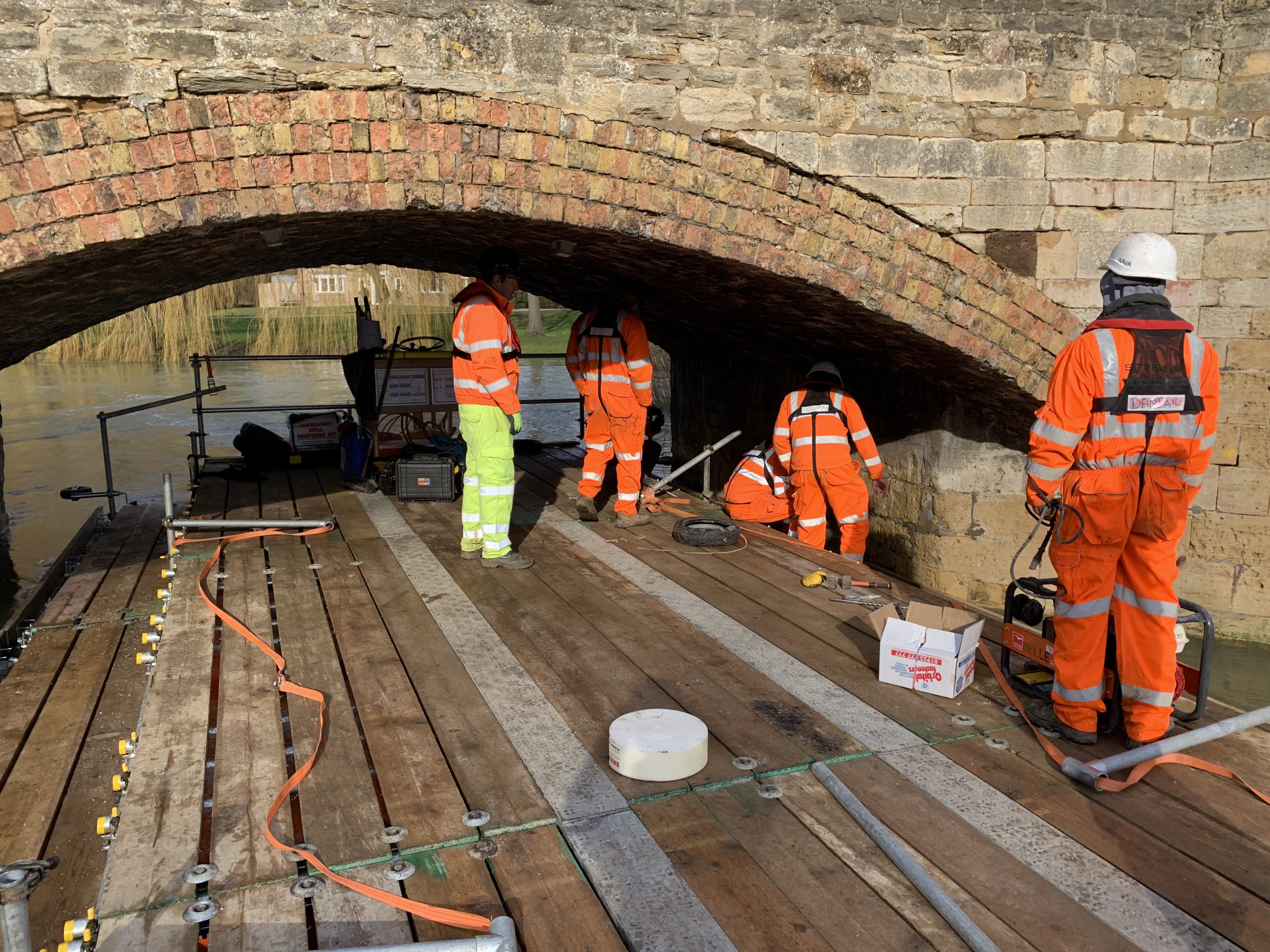
For flood rescue teams outside of the ConOp’s scope, it’s certainly a useful frame of reference. The actual level of training undertaken by a flood rescue team should be the same whether they are in Reykjavik, Glasgow, Manchester, Geneva, Zagreb or Athens. Rescue 3’s Swiftwater and Flood Rescue Technician (which meets the requirements of Defra Mod 3) is the standard to which flood rescue teams train in these cities and beyond. Rescue 3’s standard truly is global, which is a key strength when considering multi-agency and multi-jurisdictional wide scale flooding events.
For people who operate near and in water, but don’t respond to flood events, what relevance does a Defra compliant course have for them? What do they benefit from learning about the unique challenges and operational requirements within floods?
The equipment that a raft guide can carry with them whilst with a group of clients is clearly different to the equipment that a fully-stocked water rescue team can carry on their team vehicle.
Someone taking water samples, or undertaking construction work near water, is unlikely to need a full rescue capability. The risk assessment might identify that they need a self-rescue capability, or perhaps a co-worker rescue capability in the unlikely event of an emergency. It’s unlikely that they will need the same level of training as a rescue team, responding to an ongoing incident. They’re highly unlikely to be issued with the technical equipment that a rescue team would use to set up a boat on a highline or a tensioned diagonal, for example.
For the raft guide, or the recreational river user, they’re better served by the whitewater suite of Rescue 3 courses.
For industry, construction, environmental protection and monitoring, they’re best served by the industrial working in/near water suite of Rescue 3 courses. Please refer to the Rescue 3 Europe course standards, learning outcomes and key teaching points.
Establishing credibility
For organisations and busy managers, perhaps looking for or writing tenders for training for staff outside their usual area of expertise, it can be difficult to know who has the credibility to deliver the appropriate training for them. When people see ‘Defra course’, or more accurately ‘Defra compliant course’, they see that as a badge of credibility. They see the course that the flood rescue teams use, and think that’s the course for them. As we’ve established, they are better served by a course focussed on their particular operational needs. This is where Rescue 3 Europe offers the credibility that they require.
Currently, about 75% of the UK fire and rescue services receive training accredited by Rescue 3 Europe, either from commercial Rescue 3 training providers, or (as about 50% of the UK fire and rescue services do) with qualified Rescue 3 instructors delivering in-house. Similarly, over 90% of the mountain rescue teams in England and Wales, as well as lowland rescue teams, ambulance HART and police teams receiving and/or delivering Rescue 3 training according to the Rescue 3 syllabus. Many of these are part of the 50 or so organisations who register as national assets with Defra, and rightly operate under the complementary standards of Rescue 3 Europe and Defra’s Flood Rescue Concept of Operations.
By offering water safety and rescue courses beyond just flood rescue courses, Rescue 3 Europe ensures that its courses are appropriately pitched to the specific needs of clients, whilst still ensuring accrediting body oversight and development of course standards reflecting best practice.
There is a commonality of techniques on, say, a Swiftwater and Flood First Responder course (designed for emergency services) and a Safe Working In Water course (designed for industry). They both include shallow water wading techniques, as well as throwbag rescues and other conditional rescues. However, by offering courses tailored to particular areas of operation, and delivered specifically by instructors and training providers with those same areas of expertise, clients and organisations booking a Rescue 3 course can be sure that they will receive the best possible training appropriate to them.
Rescue 3 Europe oversees more than 150 training providers and over 1,250 instructors throughout Europe. They have delivered training to more than 2,000 organisations, with over 12,500 students per year undergoing Rescue 3 training within Europe. By setting standards for, and drawing experience from, these wide-ranging groups, you can be sure that developments in best practice in one area are shared and applied to other relevant areas of technical rescue and safety training.
Other complementary standards
Although we’ve looked specifically at Defra’s Flood Rescue Concept of Operations here, it’s worth noting that there are other complementary standards to Rescue 3 training. For example, in North America, the NFPA standards provide norms for water and technical rescue practices and equipment. For raft guides, whilst they might look to Rescue 3 courses for their rescue capability, it’s the IRF standards that they rightly look to for all other aspects of raft guiding.
Such standards can go hand-in-hand with each other, each focussing on their particular area of relevance. Rescue 3 Europe’s standards nerds (the most interesting and good-looking people you’re ever likely to meet) spend much of their time not only developing the Rescue 3 standards, but analysing and cross-checking other complementary standards, to ensure that the needs of all client groups are being appropriately met.
Conclusion
Rescue 3 Europe has an extensive range of water rescue and safety training courses, whoever the target audience is. There are courses for industry working on or near water, emergency responders and rescue teams and whitewater professionals. There are also specialist training courses for vehicle rescue, canyon water rescue and search. A Rescue 3 Europe training provider near you, or Rescue 3 Europe’s head office, are happy to speak with you to help you choose the right Rescue 3 course for your particular operational needs.
Become a Training Provider
How do I become a Rescue 3 Training Provider?
All Rescue 3 courses are delivered by a Rescue 3-qualified instructor, delivering for a Rescue 3 training provider. There are over 1,250 Rescue 3 certified instructors throughout Europe, delivering courses for over 150 Rescue 3 Europe training providers.
Training provider requirements
A Rescue 3 Training Provider can either be a commercial training provider (delivering to other organisations on a commercial basis), or an agency training provider (delivering in-house to their own employees). You can contact the Rescue 3 Europe office to discuss the options, and to request an application pack. We can help you through the application process and discuss your individual needs.
Once the application form has been completed, and all criteria have been met, we will arrange a site visit. Once the site visit has been successfully completed, and the relevant contracts have been signed, you will be a Rescue 3 training provider. You will be able to run your chosen Rescue 3 courses, using appropriately qualified instructors, and provide student course packs ordered through the training provider database. You will also have access to full training records of your staff and those you have trained.
Instructor requirements
Rescue 3 instructors are either:
- Agency instructors
Can only deliver within their agency - Independent instructors
Can run commercial courses to customers outside of their agency.
All instructors must work for a registered training provider.
Rescue 3 course packs
All Rescue 3 courses are registered with Rescue 3 Europe. To do this, training providers order course packs. The contents of these packs vary from course to course, but as an example consist of skill sheets, PDF or paper manuals or field guides, badges, whistles, internationally recognised accreditation and all other paperwork necessary to run the course.
Commercial courses are typically a full pack, whereas some agencies chose to order a minimum pack. This consists of only the essentials to run the course, and thereby saves on costs. There is also an option of an annual fee for organisations who can then run as many courses as they wish within their organisation.
Rescue 3 course database
All Rescue 3 training providers have access to the Rescue 3 database. This is the portal where you can order course packs, access records of previous courses, see who the instructors and students were and where the course was held, along with copies of skillsheets, and all course paperwork.
Feel free to get in touch if you need further information or want to start the process.
Further reading
The benefits of Rescue 3 training
New training provider and instructor information flyer (PDF)
Instructor and training provider pathway (PDF)
The benefits of Rescue 3 training
About us
Rescue 3 Europe is the accrediting body for these courses. We produce and develop technical rescue and safety courses in a number of fields, including water, rope, boat, confined space and ice. We accredit and oversee all Rescue 3 training providers, instructors and students within Europe. Our sister company, Rescue 3 International, does the same in the rest of the world.
Rescue 3 courses have been delivered for over 40 years, since 1979. Currently, there are over 300 Rescue 3 training providers worldwide, with 2,500+ instructors delivering Rescue 3 courses to over 60,000 students in the last 3 years alone.
Best practice
We are constantly revising and updating the content of Rescue 3 courses, to reflect best practice and industry standards. Rescue 3 courses are reviewed and revised by subject-matter experts, who form the Rescue 3 technical steering committees. The course content, learning outcomes, and instructor and student resources receive input from experts worldwide, providing a pool of expertise that is second-to-none.
Widely used
Rescue 3 courses are undertaken by all branches of the emergency services, mountain rescue, and other voluntary rescue services, at local, regional and national levels, across Europe and worldwide. In addition, the relevant Rescue 3 safety and co-worker rescue courses are undertaken by industrial and infrastructure organisations, so they have appropriate training for the complex environments they work in.
Rescue 3-trained rescuers have been on the front lines of many of the largest and most prominent technical rescues in recent years, as well as managing such incidents behind the scenes. There are also many thousands of Rescue 3-trained personnel working and operating safely in potentially hazardous environments day in and day out.
Resources
Rescue 3 students and instructors have access to a wide range of resources, developed by Rescue 3 Europe, including manuals, field guides, and video resources. These resources are available in all the course fields that Rescue 3 training providers deliver courses in, and are translated into an ever-increasing number of languages.
Standards and assessment
Every course is delivered according to the Rescue 3 standards, backed up by skill sheets, course learning outcomes, and key teaching points for instructors. Every Rescue 3 course is assessed, allowing successful candidates to leave with documentary evidence of competence. It’s important to receive the best possible training, which is offered by Rescue 3 training providers. It’s also vitally important that there’s an audit trail that allows individuals and organisations to be able to evidence that they have received training according to industry-leading standards, and evidence of assessment.
The Rescue 3 standards enable best practice, standardisation of training and multi-agency interoperability.
Database
Rescue 3’s world-leading training provider database is the central hub for all Rescue 3 training providers to log and document the training that they deliver. Every Rescue 3 student has their record of training securely stored in this database, along with full details of that course, scanned copies of the training record skill sheets with student and instructor signatures, and the qualification expiry dates. Successful students receive a PDF copy of their training certificate by email, and can optionally purchase an ID card which uses a QR code system to provide a live record of all their qualifications, which can be used as evidence of qualifications on job sites or multi-agency events.
Who trains with Rescue 3?
Emergency services
Throughout Europe, all branches of the emergency services have taken Rescue 3 training courses in water, rope, boat, confined space and ice rescue. Fire and rescue services, police and ambulance/paramedic teams are called upon to attend at such incidents. The various branches of the military have also undertaken Rescue 3 training in order to operate safely in specialised environments.
Search and rescue teams
Rescue 3 training courses are key for a myriad of search and rescue teams, both volunteer and professional. Mountain rescue, lowland rescue, cave rescue and search dog teams are regularly called upon to operate in or near water, at height or in confined spaces. Specialist animal rescue organisations also work alongside the emergency services and rescue teams, as do civil defence organisations.
Infrastructure
Workers from utilities companies operate in a variety of complex environments – at height, near water, and in confined spaces. Rescue 3 training can enable them to work safely in these environments, rescue a co-worker in the event of an incident, or operate in exceptional circumstances such as wide area flooding. Mass transit and aviation companies also have key workers who need appropriate training to operate in such environments.
Industry
Rescue 3 has a suite of safe working and co-worker rescue courses, for a range of environments, including at height, in confined spaces and near water. All branches of industry who require safety training for their employees turn to Rescue 3, including the fields of petrochemicals, manufacturing, construction, nuclear energy, renewable energy, and more.
National, regional and local government
A growing number of national, regional and local governments are adopting the Rescue 3 training standards, as prerequisites for those working in complex environments within their jurisdiction, including for infrastructure, industry and leisure tourism.
Education
At universities and colleges, those undertaking research in and around complex environments require appropriate safety training from Rescue 3. Teachers and youth workers may also require awareness or safety training, depending on the nature of their work.
Outdoor professionals
Adventure tourism organisations and adventure activity providers must have suitably qualified staff, with appropriate safety training. The Rescue 3 whitewater rescue courses are used as default training for raft and kayak guides throughout the world. Major international extreme sports events, which require technical rescue safety cover due to the nature of the environment, make use of Rescue 3-trained staff.
Precision planning and training for working safely at height
Mitigating against falls from height figures in many industrial contexts, and training excellence is pivotal to this.
Preparedness for potential accidents, a thorough understanding of hazards and appropriate training are central to achieving workplace safety. Where it comes to working at height, a fall of just a short distance can prove fatal, or leave a worker with permanent disabilities.
It’s whey the practice of developing a risk assessment is so important. Anticipating the risks and putting plans in place to combat them is consistent with widespread legislation, which exists to keep your workforce safe and well in their working lives.
If you can’t eliminate the hazard from the required task entirely, be sure you have a plan for safe working.
Part of a thorough risk assessment is, of course, anticipating the worst case scenario and it’s in just such situations that emergency procedures should be in place.
In an emergency
The UK’s Work at Height Regulations require employers to plan for emergencies and rescue, and similar requirements exist in many other jurisdictions. The best rescue is one that doesn’t have to be performed, and so the hierarchy of rescue begins with awareness of safe operating procedures. All workers must be trained by suitably qualified instructors to operate safely at height.
Self-rescue is the next step on the hierarchy of rescue. With appropriate training and equipment, workers will be able to get themselves out of trouble in the unlikely event of a minor incident occurring.
A broader awareness of rescue procedures goes hand in hand with self-rescue. A conditional rescue is one in which the victim is able to play a part to aid rescuers. The flip side of this is a true rescue, where the victim can’t aid rescuers. By their very nature, true rescues are more complicated and can be more time consuming. Clearly, an informed and trained victim will reduce risk and impact if a rescue is needed.
Following on from self-rescue is co-worker rescue. At a minimum, everyone working at height must be able to keep themselves safe, their co-workers safe, and be able to perform basic co-worker rescue. Time can be a critical factor in rescues, so it’s ideal to have a trained rescuer already on the scene and with the necessary PPE and equipment already in place. Knowing that employees can rescue a co-worker before a situation escalates is a vital part of an employer’s plan for emergencies and rescue.
Anticipating risk
An employer’s plan for rescue must begin with a risk assessment. This must take into account the obvious factors such as nature of the work being undertaken, location of that work, environmental hazards and the skill and training levels of those undertaking the work, as well as any access issues for additional rescue teams. This risk assessment will then lead on to the pre-plan for emergencies and rescue, ensuring that everyone is suitably trained, and knows how to operate if an incident occurs.
The scope of the rescue plan is directly informed by the risk assessment. At the lowest level of requirements, safe working at height training and co-worker rescue at height training may suffice. However, employers with wider requirements, in terms of worker numbers, nature of the work/facility or perhaps access/egress issues, may need to provide a stand-by rescue team. This could be staff trained to provide such rope rescue, or buying in a contracted rescue service. Whilst the statutory emergency services will probably become involved in a major incident, it is not sufficient under the regulations to rely on them to provide your rescue capability.
A rope rescue team can wholly comprise of Rope Rescue Operators, Rope Rescue Technicians, or a combination, depending on what they are tasked to do. Rope Rescue Operator training will imbue employees with a great deal of knowledge for working safely at height and undertaking rescues. Those employees who require technician-level training will begin with operator-level training. Beyond this, specialist-level training is also available for employers with more specific requirements.
A suitably trained and qualified rope rescue team can form an important part of any employer’s rescue plan. As with everything relating to health and safety, employers should hope for the best, but plan for the worst. Having employees suitably trained as a rope rescue team, prior to any involvement by the emergency services, can ensure a swift, safe and successful response to any incident.
Responsibilities and practicalities
Employers can follow a number of training pathways. The first of these is to have employees trained wholly in-house.
Regulation 5 of the Work at Height Regulations (2005) states that:
- You must ensure that everyone involved in the work is competent (or, if being trained, is supervised by a competent person). This includes involvement in organisation, planning, supervision, and the supply and maintenance of equipment.
Whilst employees may be able to pass on knowledge of day to day operations to co-workers, there is a large leap from this to meeting the competency requirements for training for emergencies and rescues. If following the wholly in-house path, an employer would have to invest heavily in an employee or employees who were developing, in isolation, an in-house training scheme that could meet the legal requirements. These employees would have to constantly keep abreast of all latest developments in the field and current best practice, as well as documenting the evidence of this experience, to satisfy any and all questions that may be asked of them in the worst case scenario of an incident occurring.
A simpler and more cost-effective training pathway is for employers to seek an external training provider, suitably accredited to deliver the highest standards of safe working at height and rope rescue training.
Regulations 4 and 6(1, 2) of the Work at Height Regulations (2005) say that you must:
- Ensure that no work is done at height if it is safe and reasonably practicable to do it other than at height.
- Ensure that the work is properly planned, appropriately supervised, and carried out in as safe a way as is reasonably practicable.
- Plan for emergencies and rescue.
- Take account of the risk assessment carried out under regulation 3 of the Management of Health and Safety at Work Regulations.
Furthermore, regulation 6(5)(b) states that:
- Where other precautions do not entirely eliminate the risk of a fall occurring, you must (as far as it is reasonably practicable to do so) train those who will be working at height how to avoid falling, and how to avoid or minimise injury to themselves should they fall.
By undertaking training with a suitably accredited external training provider, an employer will meet, and enable their employees to meet, these requirements. Of course, simply outsourcing training to a third party who doesn’t have suitable qualifications themselves won’t meet these requirements. It’s vital that any training is delivered by an organisation that is backed by a large accrediting body that offers international accreditation and recognition of their qualifications.
Larger employers, or those with very specific operational requirements, may look at the training pathway of becoming an externally accredited training provider in their own right. For an employer with staff externally accredited, there’s only a small leap to put them through instructor training and assessment with the accrediting body.
This will allow an employer to deliver in-house training, using staff that they can be sure meet all the legal requirements. These staff will have the support of an international accrediting body with an ever-expanding breadth of knowledge. With qualifications valid for a set period of time, before a simple update workshop needs to be undertaken, an employer ensures that its employees are always working to current best practice.
Specific training methods – case studies
Obviously, different industrial environments will present workers with different challenges – something that is illustrated in the following anonymised case studies, in which appropriate training not only led to cost savings but increased productivity.
Wind turbine context
A wind turbine company, operating three wind turbines with external ladders on a single site employed 5 wind turbine operators, including a team leader. In order to meet the requirements of the Work at Height Regulations (2005), the management and the team leader actively work on a plan for emergencies and rescue. However, they find that the team leader is increasingly being drawn away from their daily duties.
The management consider hiring another wind turbine operator, in order to free up more of the team leader’s time, but instead sought Wind Turbine Operator training from an external training provider which offered international accreditation.
The nature of the training is industry-specific and site-specific, but broadly maps to safe working at height and co-worker rescue at height training. The qualifications are valid for a period of three years, after which recertification is required.
The training was a mix of classroom-based and practical. Of particular use to the team leader are the lectures on UK regulations and legislation, risk assessment, pre-planning, developing rescue plans, incident size-up and incident management.
These lectures can be bespoke/developed specifically for a particular company and its operational area. In this way, the team leader was empowered to fully develop a plan for emergencies and rescue after the training – made significantly easier to communicate to co-workers largely due to the increased knowledge of the operators.
The practical sessions include training for different types of fall arrest equipment, use of lanyards and shock absorbers, emergency descending, and rescue of a co-worker from fall arrest systems. Participants said they experienced an increase in their ability to work safely at height, as well as to rescue co-workers in the event of an incident occurring, which impacted positively on workplace morale.
A shipping context
A port authority responsible for more than half a million TEUs (shipping containers) per annum employs more than 500 workers throughout the authority. Work at height and using cranes takes place continuously over a large operational area. The authority has identified that there were higher than expected working days lost per annum as a result of incidents at height and sought a solution to the concurrent goals of increasing worker safety and minimising the financial losses associated with lost working days.
Analysis of operating procedures indicated that there was scope for improvement within emergency and rescue plans, and the authority decided on a two-stage process for meeting its goals.
The first stage was for the training of a dedicated rope rescue team. This was done through an external training provider to the level of Rope Rescue Technician. For operational reasons, the rope rescue team comprised members of their on-site advanced first aid team, allowing a fully coordinated response to any incidents, and the speediest delivery of stabilisation of any patients.
The training mixed classroom-based and practical sessions. The lectures include topics such as relevant legislation, size-up, pre-planning, ICS, on-scene safety briefings, site control, medical considerations, equipment care and maintenance, and system safety checks.
Practical sessions developed from the elements of safe working at height and co-worker rescue at height training. They looked at team-based solutions that are required when co-worker rescue solutions are not sufficient. In addition to team-based raising and lowering techniques, the Rope Rescue Technicians are trained in a number of personal skills vital for their work. These include key skills, such as passing knots, anchors and deviations when ascending/descending, as well as rope transfers and changeovers. The practical sessions also cover casualty access and care elements.
The second stage of this organisations action plan will involve training key staff to rope rescue instructor status, and, over the longer term, becoming an externally accredited Rescue 3 Europe training provider in their own right. This will enable them to train their rope rescue team in-house, to the highest standards, whilst ensuring their instructors remain current with industry best practice. These instructors will also be able to train the wider body of employees to work safely at height.
The impact on reducing lost working days and improving worker safety has already been seen. Because the training is internationally accredited, it has benefitted the authority when recruiting new employees: many of them already hold this qualification, and thus are operationally up to speed much more swiftly than those who don’t yet hold it.
This article originally appeared in Health and Safety International, and is reproduced here with the author’s permission.